by Mike Brunel | Oct 19, 2021 | Leadership, Sales, Strategy
If you’ve read my last few posts. you’ll see that I’ve been discussing the mistakes business owners make ( I have made every one of them- no kidding!) when it comes to getting the right salesperson on your team.
I want to give you as much value as I can, so here are three important hoops (as I call them) that you might want to think about when it comes to employing new salespeople.
Structure Not Gut
Hoop 1- Company Culture Fit
Company Culture– While we believe that fitting in with the company culture is important, as demonstrated in the graph on our FREE report, it makes up only 10%.
Don’t get too caught up in making sure this is a major part of the recruiting process.
Create a good job description.
This is a critical factor in hiring good salespeople. When you advertise for a salesperson what do you ask?
How do you define the role? What are you looking for? What is the remuneration?
*Chet Holmes, one of my early mentors, always did this exercise when advertising for super salespeople.
Write down three initiatives that you would love to hire someone to do in your business.
Three only. Next to each one, do this:
What would it mean to your business?
How would it change your business?
Now list what you could afford to pay such people if they really performed.
Do the exercise. This forms the foundation of good a job description.
Hoop 2- Structuring an interview – History of Success.
Once you get the CV’s for the position, look for a history of success. Somewhere that you can see a challenge; a life experience that they overcame.
Structuring an interview- A structured interview process makes up 30% or a third of the process (FREE report). That’s a lot. In your structured interview, you should have some questions to ask, after reading the CV. Here are a few to start with.
How do you function as a team?
How do you feel about operating in a team environment?
Do you like working on your own outside of that team?
Can you tell me about a time when you were asked to do a project on your own? What was it?
These questions might just get the process moving.
Challenge the candidate– You are hiring salespeople to do a specific job. Human beings inherently will do anything to avoid pain. However, in the business of selling, rejection is part of what selling really is, and it can be painful.
If everyone got 100% of the business every time they presented a product, the salesperson would be out of business.
If you are hiring a salesperson to sell your product and prospecting is part of that, would you not at least ask them “What happens when you get a ‘ No!’ – How do you react?”
Ask them this, and see what happens: “ You know what, I’m not convinced that you are the right person for this job.” Observe their reaction. Do they just sit there? Or do they do something that indicates to you they might do the same with a client?
Hoop 3- Assessment Tools
This also makes up 30% of the job evaluation- We personally take a lot of guidance from these types of assessments and we go into more detail here: Download my FREE report We used to call these the B.S. detector.
We carried these assessments out in my company specifically for the roles we were looking for, in salary and performance-based positions.
Our salespeople had to work alone. We had salespeople sprinkled all over the world; usually unmanaged, working in an unstructured environment.
We had to be really clear on what we were looking for. That’s where traits/ behaviours come into play. We knew we had to hire for the task, not just the attitude.
In my next post, I explain what I look for in a salesperson, and how I came to that.
Download my FREE report to learn more, or email me… mike@mikebrunel.com

Mike Brunel started mikebrunel.com after being a successful entrepreneur and founder of NRS Media. He co-founded NRS Media in Wellington, New Zealand, expanded it into a global powerhouse in media sales and training, and was eventually responsible for opening offices in London, Atlanta, Toronto, Sydney, Capetown, and Bogota. His products and services are now sold in 23 countries and in 11 languages generating $350 million annually in sales for his clients. Mike sold the company in 2015 and now spends his time following his passions which include rugby, travel. His promise: “I can find thousands of dollars in your business within minutes – GUARANTEED” TRY ME!
by Mike Brunel | Oct 5, 2021 | Sales, Strategy
What not to do when Hiring Salespeople.
Hire in your own likeness- A potential salesperson comes in to meet with you, and within a short time you have hit it off, you may have even shared some key rapport-building facts about each other.
Of all the applicants that you have spoken with, this one is the one that you like the most. Your gut feels great, you like him, he reminds you of a younger you. You hire you.
Now you might be the best salesperson in your business, but if you want to grow, you better make sure that you do more than just hire on your gut.
It’s a good feeling to have, but there are other factors that come into play.
Fill a hole, find a salesperson.
This is a big mistake that I see all the time. Hiring under stress. As the saying goes “Hire slowly Fire quickly.” As a business owner, we do feel the pressure of getting a position filled.
Maybe, as a Sales Manager, you may feel the pressure to fill the quota and get the sales back on track. It’s natural that you push them through quickly. I have been guilty of this myself until I learned that hiring to fill a hole is a recipe for failure. How do you learn? Watching that money flush down the “you know what”!
“No one can sell as well as you do”
This one is a beauty. You are afraid to hire because they might just not be as good as you. I remember taking on a position of Sales Manager in a company, to find that the amazing sales manager I replaced had all the top clients, held onto them, and starved the team of success.
No one could sell like him I was told. Well, guess what? When I gave some of his clients to the other members of the team, the business never looked back.
If your business is going well and you want to grow, this attitude will stop you in your tracks.
Growth only comes in a business if you are prepared to hire more ‘how’ people that can free you up to help you make better decisions around what you are good at.
I can pretty much guarantee my clients a foolproof way to multiply their business tenfold. Hire more people to do the how and you do what you get excited about.
Those are the big three mistakes that business owners make when it comes to hiring salespeople.
Download my FREE report to learn more, or email me… mike@mikebrunel.com
Mike Brunel started mikebrunel.com after being a successful entrepreneur and founder of NRS Media. He co-founded NRS Media in Wellington, New Zealand, expanded it into a global powerhouse in media sales and training, and was eventually responsible for opening offices in London, Atlanta, Toronto, Sydney, Capetown, and Bogota. His products and services are now sold in 23 countries and in 11 languages generating $350 million annually in sales for his clients. Mike sold the company in 2015 and now spends his time following his passions which include rugby, travel. His promise: “I can find thousands of dollars in your business within minutes – GUARANTEED” TRY ME!
by Mike Brunel | Sep 28, 2021 | Sales, Strategy
How to hire a Superstar Salesperson each and every time
Today, I released my free report on How to Hire a Superstar Salesperson each and every time.
To coincide with releasing this free report, I wanted to share some of my thoughts around how I have hired salespeople and some key takeaways I have learned, through good and bad hires.
Who is this for?
It’s for any business owner, Sales Manager, or a startup who needs to hire a salesperson who is rewarded by a salary and performance-based performance-based
If you’ve ever hired any salespeople, like I have, you’ve usually made or have made one of these mistakes.
Just so you know, I’m fully qualified to be writing about this stuff – I’ve hired, fired, coached, or managed hundreds of salespeople, over too many years to remember, in many different countries and languages.
It’s fair to say that I’ve been through the school of hard knocks.
I hired magnificent salespeople beginning with one wonderful amazing woman, a single mum, who through sheer hard work and effort exceeded her targets in her job as a sales manager in a small media company in New Zealand.
With my main business, I was lucky to find two brothers for my U.S. operation who brought in millions of dollars.
These two superstars have certain traits, talents, and habits, that we knew would leverage our sales systems worldwide, if we could duplicate their process…. which we did.
As a result, I noticed traits in these people, secrets that I always look for. I think I know by now, what they are.
Before I go into that, let’s talk about two of the mistakes that we often make, when we go to hire salespeople.
What not to do
What’s the cost of Hiring Badly?
Think about these stats for a moment. According to a Harvard Business review article, the cost of replacing a salesperson that was hired badly ranges from $75,000 to $90,000, while other sales positions can cost a company as much as $300,000.
These figures don’t reflect the lost sales while a replacement is found and trained.
One of my good friends who owns a telecommunication company has told me a bad hire for him costs a least $1 million over time.
That’s horrendous. This may not change as we enter this new world of communication. As a company or small business, you simply cannot afford to hire on gut alone.
Is Fit Important? Maybe.
A culture fit in any business is important, there’s no doubt about that, but what you need to discover firstly is “Does this person have the ability/talent to do the job?”
That is the underlying question that needs to be asked by you as an employer of salespeople.
In the next blog, I am going to cover off some of the common mistakes that we made when we hired a salesperson for our business.
Download my FREE report to learn more, or email me… mike@mikebrunel.com
Mike Brunel started mikebrunel.com after being a successful entrepreneur and founder of NRS Media. He co-founded NRS Media in Wellington, New Zealand, expanded it into a global powerhouse in media sales and training, and was eventually responsible for opening offices in London, Atlanta, Toronto, Sydney, Capetown, and Bogota. His products and services are now sold in 23 countries and in 11 languages generating $350 million annually in sales for his clients. Mike sold the company in 2015 and now spends his time following his passions which include rugby, travel. His promise: “I can find thousands of dollars in your business within minutes – GUARANTEED” TRY ME!
by Mike Brunel | Sep 14, 2021 | Strategy
In 1963 meteorologist Edward Lorenz announced a stunning discovery.
For decades, people had viewed the universe as a large machine in which causes matched effects. “Cause and effect” it is sometimes known as, or “what you reap you sow.”
He discovered The Butterfly Effect; it is the concept of small things having major effects.
My young daughter only asked me last week if I had heard of the butterfly effect, I said it was about cause and effect, she said
“Dad, it’s about a butterfly flapping its wings in Sydney, and creating a hurricane in Atlanta.” Really I said “Yes cause and effect”
Edward Lorenz said that it specifically refers to the idea that if a butterfly flaps its wings in Beijing in March, then, by August, hurricane patterns in the Atlantic will be completely different. Here is an example of this theory:
If the butterfly in Beijing flapped its wings, it would create tiny wind patterns that would affect a passing breeze, which would, in turn, affect local wind patterns, which in turn might turn a storm slightly off course.
Since the storm’s original direction was two degrees more to the south, the storm will no longer hit a particular mountain range and dissipate. Instead, it continues in a different direction and lasts longer than it otherwise might have, which causes more weather events to happen.
I have always maintained that this very thought of making tiny adjustments, creates huge efforts. If you understand this very simple theory, then every idea you read and implement will cause some kind of effect somewhere.
Have a great week selling your stuff.
Mike Brunel started mikebrunel.com after being a successful entrepreneur and founder of NRS Media. He co-founded NRS Media in Wellington, New Zealand, expanded it into a global powerhouse in media sales and training, and was eventually responsible for opening offices in London, Atlanta, Toronto, Sydney, Capetown, and Bogota. His products and services are now sold in 23 countries and in 11 languages generating $350 million annually in sales for his clients. Mike sold the company in 2015 and now spends his time following his passions which include rugby, travel. His promise: “I can find thousands of dollars in your business within minutes – GUARANTEED” TRY ME
by Mike Brunel | Aug 24, 2021 | Negotiation, Strategy
Do you know the difference between a small sale and a large Sale
An excellent book that I have had tucked away in my library is called Spin Selling by Neil Rackman.
In Neil’s book, he maintains that there is a difference between a small sale and a large sale and different philosophies are used for both.
If you are able to know the difference between a large sale and a small sale you might just be able to save a lot of time when you go to prospect.
So what is the difference?
How does that relate to your long-term success?
If you can grasp this idea you will able to avoid all those frustrating “no calls” you keep making and begin to focus on the calls that do matter.
The general rule for small sales is the one from Neil’s book.
He is sitting in an airport waiting for a connecting flight; he was browsing in a store and spotted one of those multipurpose knives, like the Swiss Army knife, the price $15.
Within 2 seconds of seeing it, he bought it and his immediate need was satisfied. To him, it was what I call a no-decision decision.
Now, what about a bigger sale? Let’s take another scenario, you are meeting your client for the first time, potentially that client could invest with you several thousand dollars worth of product or services.
Are you going to get him or her to buy on the first call?
The best way to approach the larger sale is to expect that it may take a little longer. They simply have different needs than smaller sales.
Here a sure fire way to make sure that you do know the difference:
- A larger sale will contain more than one decision maker
- A larger sale involves asking more specific questions about their problems and moving them up to solutions.
- Larger clients tend to take a more rational approach to decision making than a smaller client.
Do this on a regular basis and monitor what are your small sales and your larger sales.
One action you can take straight away is write down all you larger clients based on spend and see if this does stack up against the criteria above.
List all your larger clients in a notebook and begin to ask questions to discover the needs over time.
Have great fun selling your stuff.
Mike
Mike Brunel started mikebrunel.com after being a successful entrepreneur and founder of NRS Media. He co-founded NRS Media in Wellington, New Zealand, expanded it into a global powerhouse in media sales and training, and was eventually responsible for opening offices in London, Atlanta, Toronto, Sydney, Capetown, and Bogota. His products and services are now sold in 23 countries and in 11 languages generating $350 million annually in sales for his clients. Mike sold the company in 2015 and now spends his time following his passions which include rugby, travel. His promise: “I can find thousands of dollars in your business within minutes – GUARANTEED” TRY ME
by Mike Brunel | Aug 4, 2021 | Sales, Strategy
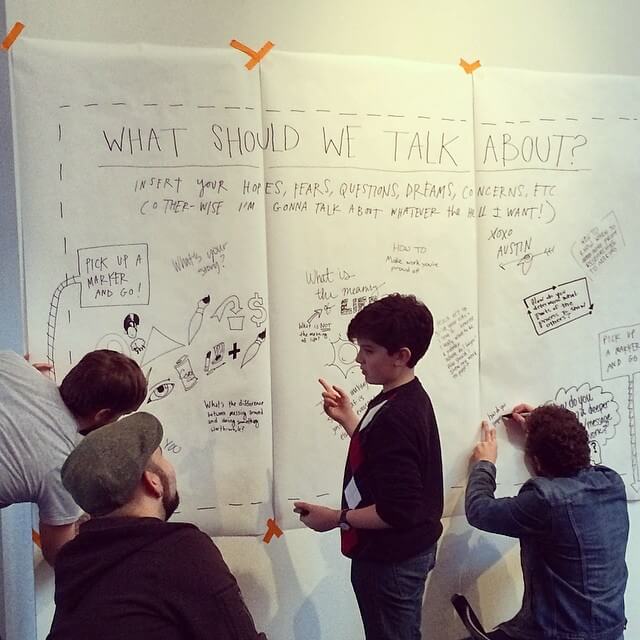
Photo – Austin Kleon- Steal like an Artist
“Are Sales are contingent upon the attitude of the salesperson? Or the attitude of the prospect”
I get to hear good stories from all over the world as to how salespeople are making a difference to people’s lives.
In many situations businesses worldwide are feeling (according to them) the pressure of not getting their numbers, the market is tough, it is not like it used to be, people are simply not buying like they used to, the excuses seem to go on and on.
I want to debunk that, it simply is not true. I know that if you offer value, and are committed to your customers, they will buy off you.
Money is still there.
The truth is that the money is always there, it may be less for some, but nonetheless, it is always there, it just moves around. It might move from your business to another, but the facts are that that retail revenue is up in countries like NZ and Australia.
It might move from your business to another, but the facts are that that retail revenue is up in countries like NZ and Australia.
The thing is that businesses have to do things differently; they need to think about how their clients are purchasing their product.
I can guarantee that in most homes these days television and other media is not the main source of entertainment or information.
The internet has become a big part of our lives.
Clients do research your product along with your competitors before they even venture into your store or place of business.
Information is Power.
Many business owners that I have worked with all over the world have had to come to terms with a changing market.
The ones I notice that are doing well train their staff on a regular basis, keep them up to date with all the new products or services, help them make the decisions, this is done usually at least once a week.
In any business product knowledge is based upon attitude, if you visit a store and a staff member does not know their product what happens?
You lose confidence, you are not really sure if they are to be trusted, you might retreat, and go off to someone else.
Want a secret to more Sales?
Product knowledge and information about a product have an invisible benefit. It gives the salesperson the “right attitude” it rubs off. They get confident, and the clients feel that confidence.
Try these simple exercises that work.
Here a just two exercises you can do in your business to get your team to buy into product knowledge training.
- POP QUIZ- write up 10 benefits of your most popular products, list what you think is the #1 benefit for the customer if they buy this product.
- TEST ONE ON ONE, OR IN A TEAM MEETING – Give each of your staff a test on every one of those products. You can do it in written form or as part of their one on one meeting.
These simple tests can give your business a foot up and you might get an extra share of the money that is out there.
Have a great day selling your stuff.
Mike
PS. If you want a simple test format to help you do that then download our 7 day Sales Mindset Challenge. Or if you need help to help your team make more sales or get more leads then contact me.
“Sales are contingent upon the attitude of the salesperson, not the attitude of the prospect” –William Clement Stone.
