
by Mike Brunel | Jul 21, 2026 | Sales
Every salesperson gets ghosted. What you send next decides whether that door stays open.
Here’s the problem.
A prospect goes quiet after showing interest. Most people either chase them with three more follow-ups or give up and disappear.
I can promise you this: neither one works. Both come from the same place. Fear of the answer being no.
Here’s the insight.
The email that gets replies isn’t the one that pushes hardest. It’s the one that removes all the pressure.
Here’s the framework.
Four moves make this work. Each one does a specific job.
Subject line: Sorry.
That alone gets it opened. People are curious what they’re being apologised for.
Take the blame first.
“I can only assume I messed something up along the way.” This isn’t weakness. It builds trust and tells them their vendor puts their interests first.
Name the possible reasons.
“Was the price too high? Confusing presentation? Competing priorities?” A menu is easier to answer than an open question. And naming the objection out loud takes some of the sting out of it.
Detach from the outcome.
“Which is not a problem at all.” You’re not chasing the deal. That single line does more to lower their guard than anything else in the email.
Put it together, and it reads like this.
“Hey [name], looks like you’ve decided to pass on working with us, which is not a problem at all. I can only assume, based on your initial interest, that I messed something up along the way. Sorry about that. Would you be open to sharing some feedback so I can do better next time? Was the price too high? Confusing presentation? Competing priorities? Either way, I know there’s a lot competing for your time and attention. Thanks for the opportunity.”
I’ve used a version of this email for years. Ninety per cent of the time, the answer comes back the same way. “No, no problem, Mike. I liked it. Just not ready yet.”
Here’s the application.
Find one contact who’s gone silent on you right now. Write your version of this email. Sorry subject line. Take the blame. Give them a menu. Let them off the hook completely.
Send it today.
Sales is easy. Salespeople are made.
Mike (Rejection) Brunel
by Mike Brunel | Jul 15, 2026 | Sales
Two Salespeople. Same Company. Very Different Results.
Let me tell you a story about two salespeople.
One is called Victoria. The other is Sam. They work for the same company.
They’ve received the same training, have the same manager, put in similar effort, and complete the same sales activities.
Yet their results couldn’t be more different.
Victoria consistently exceeds her target every month.
Sam works just as hard but always seems to fall short.
So why?
Many Sales Managers assume it’s an attitude or effort problem.
They coach harder.
They send Sam on more training.
They increase activity targets.
But nothing really changes.
Why?
Because the issue isn’t above the surface.
It sits underneath.
It’s not simply about what they’re doing.
It’s about how they’re naturally wired to sell.
Until you understand a salesperson’s natural strengths, blind spots, and coaching needs, you’re often treating the symptoms instead of the cause.
So here’s my question.
How many Sams do you have in your business?
Keep Victoria
More importantly…
What are you doing about it?
Maybe I can help.
I have 2 free spots in my Sales DNA programme every month.
If you want to know more, DM me.
Mike
Sales DNA Coach.

by Mike Brunel | Jul 6, 2026 | Sales
Over the years, I’ve noticed something interesting.
The businesses I enjoy working with most don’t usually have a sales problem.
They have a sales perception problem.
They want more revenue.
They want more opportunities.
They want their people to have better commercial conversations.
But they don’t want to become “salesy.”
You know the stereotype.
The shiny shoes.
The hard close.
The commission breath.
The pushy tactics.
The problem is that many business owners believe the only way to grow revenue is to create more salespeople.
I disagree.
The best businesses I’ve worked with don’t grow by becoming more aggressive.
They grow because they become more commercially confident.
There is a big difference.
Commercial confidence means being comfortable starting conversations.
Being comfortable asking questions.
Being comfortable talking about value.
Being comfortable discussing money.
Being comfortable asking for commitment when the time is right.
Most people already know how to do the technical part of their job.
The challenge is helping them feel comfortable having the commercial conversations that support growth.
That’s one of the reasons I developed Sales DNA.
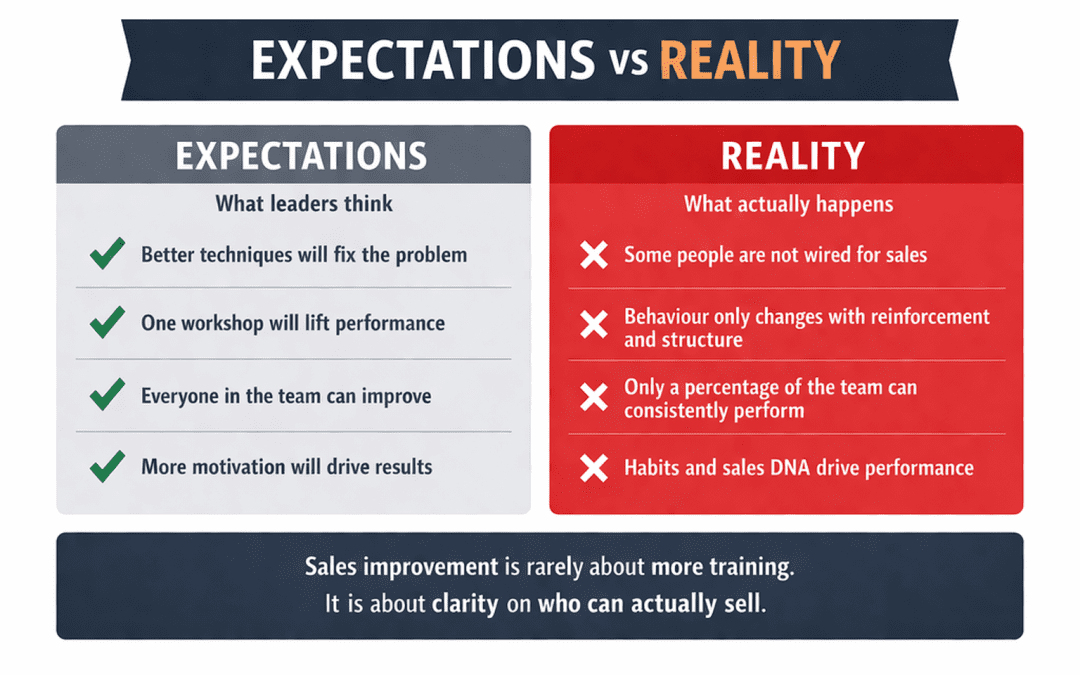
When performance slows, most organisations immediately jump to training.
More scripts.
More workshops.
More product knowledge.
More sales techniques.
Sometimes the problem isn’t skill.
Sometimes it’s confidence.
Sometimes it’s mindset.
Sometimes it’s natural sales wiring.
Sometimes it’s a lack of structure.
Before we tell people what to do, we need to understand what’s actually getting in the way.
The businesses that get the best results are rarely trying to create a team of salespeople.
They’re trying to create a culture where people are confident enough to create opportunities, build relationships, ask for business, and follow through consistently.
That’s a very different objective.
The goal isn’t to make your team more salesy.
The goal is to make them more commercially confident.
And when that happens, revenue growth tends to follow.
Have a great week selling your stuff.
Mike Brunel
