by Mike Brunel | May 27, 2026 | Leadership
Why do downside thinkers often become the hidden cost inside sales teams?
One of the biggest hiring mistakes sales leaders make is assuming skills and attitude are the same thing.
They are not.
Skills can be trained.
Attitudes are far more deeply wired.
I work closely with the Self-Management Group, and in a recent article, John Maxwell discussed downside thinking. These ways of looking at things are often formed by a person’s late teens or early twenties.
Over time, these become habits, ways of interpreting the world and responding to pressure, setbacks, feedback, rejection, and authority.
That matters enormously in sales.
Sales is not only about skill. Emotional resilience matters, too.
You can teach someone how to prospect.
You can teach objection handling.
You can teach presentation structure.
As John writes, it is far harder to teach optimism, ownership, emotional responsibility, and the ability to stay constructive under pressure.
He then introduces downside thinking.
A downside thinker naturally focuses on problems first. What is wrong? Who failed them? What frustrated them. What they dislike. Why something won’t work.
And the scary part?
Many downside thinkers interview extremely well.
They can sound intelligent, analytical, experienced, even self-aware.
Behind polished answers often lies a pattern of blame, negativity, frustration, and low motivation.
One of the simplest ways to identify this during recruitment is through open-ended questions such as:
“What do you think about your current or previous manager?”
The answer itself matters less than the order and emotional tone of the response.
Downside thinkers usually lead with negatives.
“Well… to be honest, communication wasn’t great.”
“They didn’t really support the team.”
“There were a lot of problems there.”
“I got frustrated because…”
Only later do they mention positives.
Upside-down thinkers tend to do the opposite.
They naturally begin with balance, perspective, and positives.
“She was actually very supportive.”
“I learned a lot there.”
“There were definitely challenges, but…”
“He pushed me hard, which helped me grow.”
This reflects what many psychologists refer to as a healthier positive-to-negative ratio. In practical terms, upside-down thinkers generally approach situations with more emotional stability and constructive thinking.
Why does this matter so much in sales?
Salespeople live in an environment full of ambiguity, rejection, pressure, and setbacks.
A downside thinker often interprets:
No response as rejection.
Feedback as criticism.
Targets as pressure.
Change as unfairness.
Prospecting as emotional risk.
Over time, they affect team culture, lead to resistance to coaching, and create friction within teams.
Upside thinkers are not unrealistic or blindly positive. They simply recover faster. They maintain perspective. They look for solutions before blame.
This can influence everything.
Especially in leadership.
Even one downside thinker can affect morale, coachability, and performance across a team.
The uncomfortable truth is this:
Many businesses spend enormous amounts of money trying to train people out of attitudes they should never have hired in the first place.
That is why assessment tools, behavioural interviewing, and deeper emotional pattern recognition matter more than ever.
The lesson is simple.
Stop hiring chronic downside thinkers.
Because while skills can improve surprisingly quickly…
Attitudes usually don’t.
Great advice from John. If you want help with sales team challenges, reach out to our team.
Have a great week.
Mike
by Mike Brunel | Mar 31, 2026 | Leadership, Strategy
Here’s what every Sales Manager /Owner expects when they hire someone.
Hire well. Train them. They perform.
Simple. Logical. Obvious.
Here’s what actually happens.
Good interview. Weak performance. More coaching. Frustration.
Sound familiar?
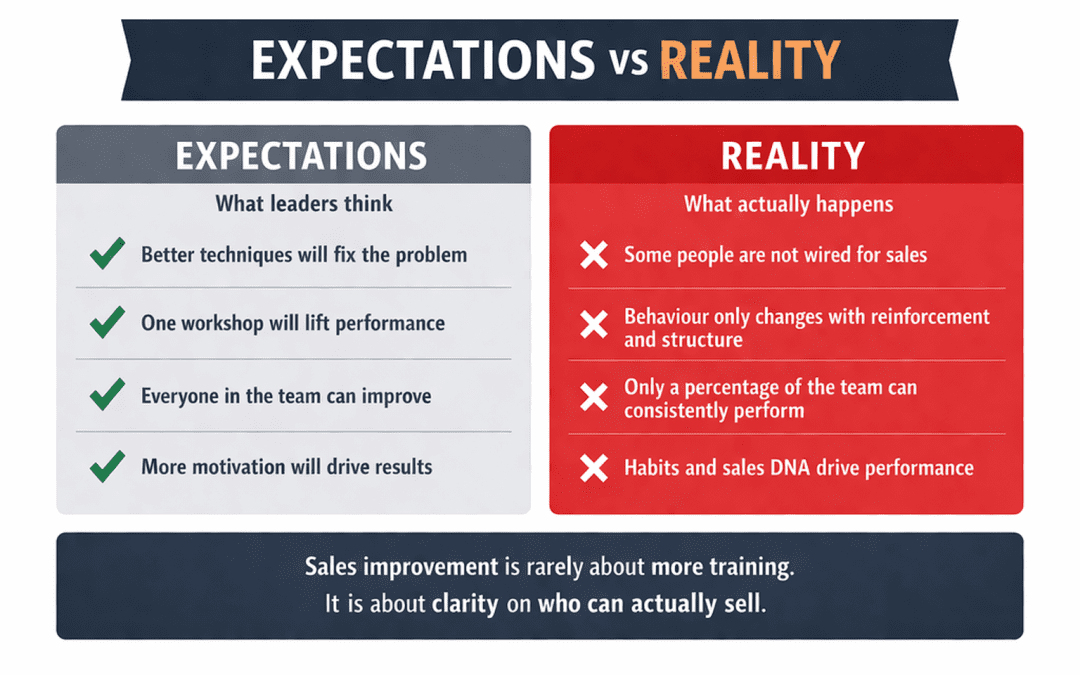
EXPECTATIONS VS REALITY
——————————————————————————————————
Better techniques will fix it / Some people are not wired for sales
One workshop lifts performance / Behaviour only changes with reinforcement
Everyone in the team can improve / Only a percentage consistently perform
Motivation drives results / Habits and sales DNA drive performance
——————————————————————————————————–
The gap between what we expect and what actually happens, that’s what I call the Sales DNA gap.
Most sales trainers operate on the left side of this slide.
The problem is… the business is usually living on the right side.”
Each month, I work with 5 clients to help them operate on the right side. If you are interested, just hit the reply button with “I’m in, and I will send you the details.
Have a great week selling your stuff.
Kind regards
Mike
P.S. If now is not the right time to explore this further, I would still be happy to send you a free copy of my book Selling is Not Optional.
It explains why selling is a conversation rather than a confrontation and outlines the habits that help salespeople prospect, open conversations and close with confidence.
There is no cost and no obligation.
Just reply BOOK, and I will send you a copy.

by Mike Brunel | Mar 11, 2026 | Leadership, Sales
A simple insight about “priority clients” that turned presentations into almost-guaranteed sales.
Sales Leaders and Sales Managers, a question?
Do you actually know your clients?
One of NRS Media’s great successes was our ability to truly understand our client base.
Knowing who actually bought advertising, and why, was a key factor in the company’s success.
We achieved that by studying the categories of businesses that consistently bought media.
Our business operated globally out of Wellington, New Zealand, Sydney, Australia, then in the USA, UK, Europe, and South Africa, and even Bogota…
We travelled from city to city, working with media companies, presenting advertising opportunities ranging from $5,000 to $20,000 per client per year.
We listed it to only 100 clients. It sold out on those markets year after year.
Over time, we began to notice something interesting.
For certain clients who attended the presentation, almost always bought.
So we decided to analyse the data more carefully.
We didn’t have any sophisticated AI or CRM to manage that data; we just really worked hard with our clients to ask them why they bought.
When we isolated what we called “priority clients,” we discovered something remarkable.
If those clients attended the presentation, close to 100 per cent of them purchased the programme.
But there was another pattern.
These were also the clients who received a personal invitation to attend.
Once we understood that, we became very deliberate about how we treated those prospects.
If someone fitted the priority profile, we did everything possible to get them into the room.
We dressed up invitations in branded-style envelopes.
We delivered invitations in presentation boxes with ribbons.
We hand-delivered them whenever possible. ( Our most successful strategy.)
Sometimes we even picked people up and chauffeured them to the event.
In other words, we treated them like the near-certain sales we knew they were.
As a result, our acquisition costs dropped significantly while our conversion rates remained incredibly high.
The famous copywriter Dan Kennedy calls these people “hidden buyers properly exploited.”
The first key was profile.
We worked out exactly who these buyers were.
We studied their demographics, their behaviours, and the types of businesses most likely to purchase media advertising.
Once we understood that profile, we could predict a sale with high confidence.
The second factor was timing.
Many of our ideal buyers were older, established businesses that wanted to keep their name consistently in front of their customers.
Advertising wasn’t a gamble for them. It was a long-term brand strategy.
There’s a powerful lesson in this for any business.
Once you truly understand who buys your product or service, everything becomes easier.
Your marketing becomes clearer, your sales process becomes more focused, and your conversion rates improve dramatically.
The key is simple.
Find your hidden buyers.
Understand their profile.
And make sure they show up.
Have a great week selling your stuff.
Mike.
P.S. I am looking for 5 Sales Leaders who want to work with me to identify who on your team can sell, who can prospect, and who are trainable.
by Mike Brunel | Feb 13, 2026 | Leadership
Most sales hiring is stuck in the same comparison trap.
“We hire experienced reps.”
“We hire motivated people.”
“We hire good communicators.”
“We hire people with a proven track record.”
Sounds sensible, right?
Feels responsible.
Still loses in my opinion.
Why?
Because it’s just better, not different.
Every recruiter. Every sales manager. Every HR team is saying the same thing. Candidates are compared on CVs, gut feel, and interview performance.
And when everyone looks “good enough,” hiring becomes a gamble.
I think that is a trap.
Now here’s where the POP7 Assessment flips the power dynamic.
POP7 doesn’t help you hire a better salesperson.
It makes you stop comparing altogether.
Instead of asking “Who sounds good in the interview?”
You ask, “Who is actually wired to sell in this role?”
POP7 measures Sales DNA.
The stuff that doesn’t show up on a CV.
The stuff reps can’t fake in an interview.
Things like:
How they handle rejection.
Whether they initiate or wait to be told.
If they can push through discomfort.
How do they self- manage when no one is watching?
Once you see that, the comparison game ends.
You’re no longer choosing between candidates.
You’re choosing between fit and future problems.
This is the same shift companies like Uber made.
They didn’t say “we’re a better taxi.”
They made taxis irrelevant.
POP7 does the same thing to sales hiring.
You’re not choosing between two reps anymore.
You’re choosing between
Predictable performance
Or rolling the dice and hoping.
That’s why price stops being the conversation.
Because POP7 isn’t an assessment.
It’s a decision filter.
It answers one question clearly and early:
“Is this person built to sell here or not?”
Once you have that, everything else becomes secondary.
That’s how you escape the hiring price war.
That’s how you stop guessing.
That’s how you become the only logical choice.
I have 5 opportunities for February to help you recruit, train and hire the right salesperson.
If you are interested in my Sales DNA programme, reply in the comments with “Sales DNA”, and I will send you the details.

by Mike Brunel | Nov 17, 2025 | Leadership, Uncategorized
Why Some Sales Teams Love Mondays… and Others End Up in the RIP Zone
If you’ve been in sales leadership long enough, you already know this truth:
Monday morning exposes everything.
Some managers walk in smiling, because the numbers are lining up.
Others walk in bracing for the post-mortem, the weekly RIP for the pipeline.
This is the heart of any sales team performance review.
It’s not about spreadsheets, dashboards, or colourful charts. It’s about people — and whether they walked into the week with discipline or drift.
Two Teams, One Monday
I’ve coached teams where Monday feels like a launchpad, reps arrive with energy, clarity, and a plan.
And I’ve coached teams where Monday feels like a funeral service for last week’s excuses.
Here’s the difference:
Some reps show up ready to create new conversations.
Some show up waiting for the phone to ring.
You already know which group drives your revenue.
The One Question That Tells You Everything
If 20–30% of your team consistently underperforms, try asking this simple prospecting question:
“Walk me through your plan for creating new conversations this week.”
That’s it. No pressure, no complicated framework, no interrogation.
This single question does three powerful things:
1. It reveals their process.
If there’s structure, they’ll show it.
If there’s no structure, you’ll see the blank stare instantly.
2. It reveals their initiative.
My favourite part.
High-potential reps speak proactively , they’ve already mapped out their activity.
Low-potential reps speak reactively, they talk about what they’re waiting for.
3. It reveals their problem-solving ability.
Great reps lay out a clear path.
Strugglers drift into excuses, deflections, or vague “I’ll try to make some calls” lines.
Why This Matters More Than Ever
Sales is a performance business. Always has been.
But today’s environment, remote selling, distracted buyers, tighter competition — means that personal accountability is everything.
Your Monday question isn’t just a check-in.
It’s a reset button.
A calibration.
A chance to help your team own their week before the week owns them.
How to Make It Part of Your Rhythm
- Start every Monday with it.
- Ask it 1-on-1 or in team meetings.
- Listen for clarity, ownership, and forward motion.
- Coach on gaps immediately — don’t wait until Friday.
Small question.
Big shift.
And it works every single time.
Have a great week selling your stuff.
— Mike Managers and Sales Directors Love Monday mornings!
Well, some do and some don’t, the week in review, or RIP for some.
For some, it’s going to be a great review. For some, it’s going to be RIP.
Reps are insufficient and simply not performing. What’s RIP in today’s sales world?
You have some team members who wait for leads, quickly lose focus, and need constant pushing.
If you are in that world for 20% 30 % of your team, ask this prospecting question: “W𝙖𝙡𝙠 𝙢𝙚 𝙩𝙝𝙧𝙤𝙪𝙜𝙝 𝙮𝙤𝙪𝙧 𝙥𝙡𝙖𝙣 𝙛𝙤𝙧 𝙘𝙧𝙚𝙖𝙩𝙞𝙣𝙜 𝙣𝙚𝙬 𝙘𝙤𝙣𝙫𝙚𝙧𝙨𝙖𝙩𝙞𝙤𝙣𝙨 𝙩𝙝𝙞𝙨 𝙬𝙚𝙚𝙠.”
Here is the takeaway: It does three things for you.
It reveals their process. If there’s no structure, you see it instantly.
It reveals their initiative- 𝗠𝘆 𝗳𝗮𝘃𝗼𝘂𝗿𝗶𝘁𝗲
High-potential reps talk proactively.
Low-potential reps talk reactively.
It reveals their problem-solving ability.
They’ll either give you a clear path, or they’ll drift into excuses.
Sales is a performance business, nothing more, nothing less.
Have a great week selling your stuff.
Mike

by Mike Brunel | Oct 5, 2025 | Leadership, Uncategorized
Love helping my clients.
“Mike comes with a wealth of knowledge & expertise that is unparalleled by anyone I’ve met before. He’s helped me improve my business development strategies and grow our business. I highly recommend working with him!”
PD
Mike
(Plus, whenever you are ready… here are three ways I can help you grow your business.)
1. Grab a Free copy of my book
It’s the sales roadmap to attracting prospects, building, and making more sales in your business without coming across as salesy- Click Here.
2. Join the Sales Mindset Inner Circle and connect with salespeople like you.
It’s our new Facebook community where salespeople learn to get more income, enhance their ability, and get access to exclusive content- Click Here
3. Join –“Sales Mindset Blueprint: (INVITATION ONLY) Elevating perspectives, boosting confidence, driving results and not coming across as salesy. Reply to SALESY, and I will get you the details.
