by Mike Brunel | Jun 22, 2026 | Sales, Strategy, Uncategorized
Your sales issue might be a hiring issue, not a training issue.
“We’ve booked them on another course.”
“They just need more confidence.”
“They’ll improve once they know the product.”
Familiar. Logical. Often wrong.
I can talk from experience: many businesses invest heavily in coaching, but see little change in results.
Over the years, I’ve found that the best salespeople usually share three natural qualities: they enjoy prospecting, they’re comfortable asking for commitment, and they don’t let rejection knock them off course.
What we do, though, is chuck a workshop at them, and that’s the training done. Now off you go and get the sales.
With changes in recruitment and AI, use science, good interview questions, and cultural selection.
You owe it to your team.
Let me know if you need this type of salesperson for your team.
Mike

by Mike Brunel | May 6, 2026 | Strategy
Every year, I receive a calendar in the mail from one of my coaches, with whom I have worked for several years.
His name is Dan Kennedy.
“A calendar, you might say, what they still send out calendars!”
A bit old-fashioned, don’t you think? I have a phone for that.
His calendar is not like the one you receive from your insurance agent with nice scenes of places that you have never seen.
He has great ideas on every page, every month, for you to think about.
This month, I flipped over the month of May, and this is what I found.
A question…
“If I could just…………………….”
Four words that could change your sales life overnight.
Try this…
If you want to know and identify what the key problem your client may have, fill in the blank as if the client were asking this question
“If I could just……………………..”
How does your customer finish that sentence?
If you know that, it will give you tremendous leverage and advantage and allow you to construct an offer that is almost irresistible to your client.
Have a great week selling your stuff.
Mike
by Mike Brunel | Mar 31, 2026 | Leadership, Strategy
Here’s what every Sales Manager /Owner expects when they hire someone.
Hire well. Train them. They perform.
Simple. Logical. Obvious.
Here’s what actually happens.
Good interview. Weak performance. More coaching. Frustration.
Sound familiar?
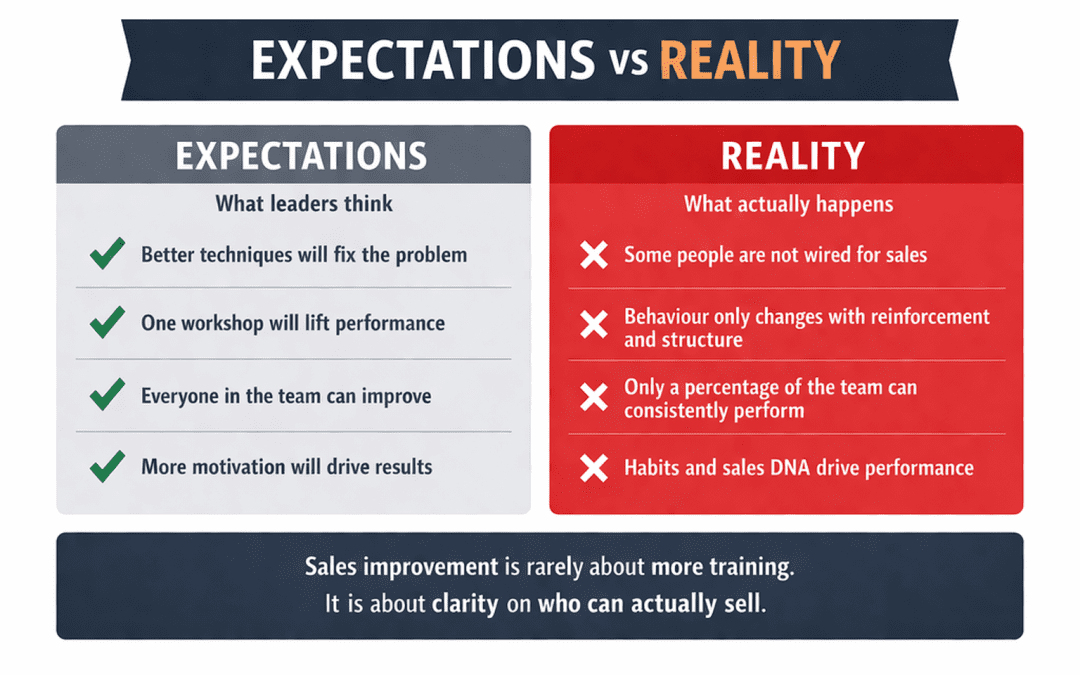
EXPECTATIONS VS REALITY
——————————————————————————————————
Better techniques will fix it / Some people are not wired for sales
One workshop lifts performance / Behaviour only changes with reinforcement
Everyone in the team can improve / Only a percentage consistently perform
Motivation drives results / Habits and sales DNA drive performance
——————————————————————————————————–
The gap between what we expect and what actually happens, that’s what I call the Sales DNA gap.
Most sales trainers operate on the left side of this slide.
The problem is… the business is usually living on the right side.”
Each month, I work with 5 clients to help them operate on the right side. If you are interested, just hit the reply button with “I’m in, and I will send you the details.
Have a great week selling your stuff.
Kind regards
Mike
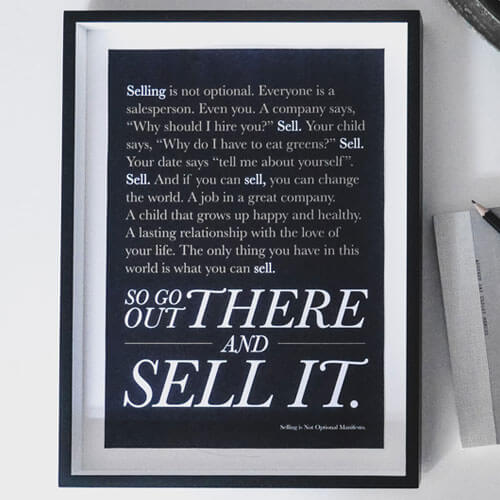
P.S. If now is not the right time to explore this further, I would still be happy to send you a free copy of my book Selling is Not Optional.
It explains why selling is a conversation rather than a confrontation and outlines the habits that help salespeople prospect, open conversations and close with confidence.
There is no cost and no obligation.
Just reply BOOK, and I will send you a copy.
by Mike Brunel | Dec 25, 2025 | Sales, Strategy, Uncategorized
I am often asked what makes good sales training and coaching.
Here are five tips to help you make the right decision when hiring a sales trainer or coach.
1. The sales team don’t see the sales training as relevant to them.
Usually what happens is that a sales person will be sent on a sales training course and they get there and it’s straight out of a manual. Taught to them by rote and disappointing.
2. The ‘one size fits all’ approach doesn’t suit their business situation.
The trainer has not spent the time to evaluate the salesperson’s needs. Tailor making specific programmes work better. Before any training ask the sales trainer to work with you on YOUR outcomes for the training programme.
3. Lack of Outcomes once at the course.
This is similar to point two, sales people have different needs, just like their clients, many times sales people arrive at course and at are never asked what their specific outcomes today for this course.
4. Sales trainer, not a sales person.
In this case, it’s more about creditability, if the trainer has no experience selling in any form, it’s difficult to build rapport with the audience you are training. The theory is fine, but not realistic. Sales experience is must for a trainer.
5. Learning as you go.
If the training is not carried out in an environment of learning and facilitation it’s seen as boring and lacking in depth. In the ever increasing world of soft skills training involving your participants in ‘learning by doing’ is a must.
These tips have certainly helped my clients and may help you.
Good selling
ABOUT THE AUTHOR:
Mike Brunel – Author, Sales Trainer and Coach at Mikebrunel.com. Mike started mikebrunel.com after being a successful entrepreneur. He was a co-founder of NRS Media a global leader in media sales. His products and services generated $350 million a year in revenue for his clients. He sold that business in 2014 and now consults to business owners throughout New Zealand and beyond. He works with any business that wants to increase sales that have a sales turnover of 1/2 million up to $10 million. He works closely with digital and marketing services to help attract sales for his clients.

by Mike Brunel | Nov 20, 2023 | Sales, Strategy
The Salesperson’s Checklist: Honing Your Questioning Skills
Over the last few weeks, we have been talking about all sorts of questions. Sales Questions, personal questions, goal-setting questions, open questions,
In the dynamic world of sales, the ability to ask the right questions is a game-changer.
As promised from last week’s blog, here’s a practical checklist I compiled from these articles to help you think about having effective conversations and better results.
1. Prepare Your Mindset
- Understand the value of questions in building relationships.
- Shift focus from selling to learning about the client’s needs.
2. Research Your Client
- Gather background information about the client and their business.
- Identify potential challenges they might be facing.
3. Develop Open-Ended Questions
- Create questions that cannot be answered with a simple yes or no.
- Ensure your questions are relevant to the client’s context.
4. Practice Active Listening
- Focus fully on the client’s responses.
- Avoid planning your next question while listening.
- Show that you are listening through nods and affirmations.
5. Follow-Up Questions Are Key
- Develop follow-up questions based on the client’s responses.
- Dig deeper to uncover underlying needs or challenges.
6. Balance the Conversation
- Ensure that the client does more talking than you.
- Guide the conversation without dominating it.
7. Read Non-Verbal Cues
- Pay attention to the client’s body language and tone.
- Adjust your approach based on these cues.
8. Reflect and Learn from Each Interaction
- After each meeting, review what went well and what didn’t.
- Continuously refine your questions based on past experiences.
9. Practice, Practice, Practice
- Regularly role-play sales scenarios with colleagues.
- Seek feedback on your questioning technique.
10. Stay Curious and Empathetic
- Maintain genuine curiosity about your clients’ needs.
- Cultivate empathy to connect with clients on a deeper level.
This checklist is designed to be a living document for sales professionals.
Regularly revisiting and updating your approach to questioning can lead to more meaningful client interactions and successful outcomes. Remember, the right question at the right time can make all the difference.
Good selling this week.
Mike
PLUS, whenever you are ready…here are ways I can help you grow YOUR business.
1. Join my free Facebook group – Sales Mindset Inner Circle
My favourite thing to do is show you what’s working right now. It’s not as good as being a client, but it’s close.
2. Take advantage of a FREE 45-minute consultation
Need some sales support? it. Please make an appointment, and let me take you through the past, present, and future templates.
Finally, grab my new digital book on ‘How to get a predictable sales system into your business without coming across as salesy’
by Mike Brunel | Oct 2, 2023 | Sales, Strategy
“Size Does Matter when it comes to selling.
For valuable insights into distinguishing between small and large sales, consider reading Neil Rackman’s best-selling book, ‘Spin Selling.’ Several years ago I was introduced to it and found it very useful when selling larger offers.
“Distinguishing Between Big and Small Sales”
Rackman emphasises the fundamental differences between a large sale and a big sale.
He believes each requires distinct closing techniques.
Recognising these differences can save you significant time and increase your chances of success when approaching prospects.
What Defines a Small Sale?
In ‘Spin Selling,’ Rackman shares an illustrative anecdote. While waiting for a connecting flight at an airport store, he spontaneously purchases a versatile Swiss Army knife for just $15.
The time elapsed between recognising the need and making the purchase was mere seconds, highlighting a characteristic of small sales – swift transaction times.
Additionally, small sales typically involve minimal risk.
Rackman’s $15 expenditure on the army knife presented minimal financial exposure.
Small sales often stem from impulsive decisions driven by emotional motives.
In Rackman’s case, practical necessity did not drive the purchase; it was an emotional impulse.
How Does a Large Sale Differ?
Now, consider a different scenario: meeting a prospective client who may potentially invest several thousand dollars in your company.
To secure such a substantial sale on the first call, you must exercise patience and anticipate a more extended sales process.
Large sales usually entail a longer transaction timeline, as the need develops over time.
To help you recognise the difference, here are some key indicators:
- Multiple Decision Makers: In larger sales, there are typically more decision-makers involved. Be prepared to engage with a team of more than one decision-maker.
- In-Depth Problem Solving: Large sales require you to ask more specific questions about the customer’s problems and collaborate on finding comprehensive solutions.
- Rational Decision-Making: The decision-making process for larger sales tends to be more rational and deliberative on the part of the customer or client.
Understanding the way your customers think, the impact of their decisions on their own career
Try this:
Create a list of your clients who have engaged in large-scale purchases, categorised by the size of the sale. Compare this list with the criteria outlined above.
Be open to thinking differently and have patience.
Happy selling, everyone!
Mike
Have a great week selling your stuff.
Mike
PLUS: WHENEVER YOU’RE READY…Here are 4 ways I can help you make more sales in your business – big or small.
1. Want to become a Sales Mindset Blueprint Member? You get access to an exclusive coaching session with me and full access to my sales programme every month. Get the deets here.
2. Try the new ‘7 Days to Sales Success’ framework. Make more sales in 7 days—the framework of everything you need to start making more sales in your business. The Sales Success Framework is based on a simple 7-day challenge. Click here to learn how to grow your business by making more sales.
3. Join our private Facebook group – The Sales Mindset Inner Circle. Get all the latest up-to-date sales ideas. Every week, we do Facebook Live updates on all things sales. Tips, ideas, free coaching, and much more. Join me by clicking here
4. Could you work with me one-on-one? If you’re a small or large business owner or in professional services, you might have a few strategies, tactics and tools away from doubling your lead flow, revenue and impact. Please jump on a FREE 30-minute brainstorming call with me by clicking here.
