by Mike Brunel | Mar 31, 2026 | Leadership, Strategy
Here’s what every Sales Manager /Owner expects when they hire someone.
Hire well. Train them. They perform.
Simple. Logical. Obvious.
Here’s what actually happens.
Good interview. Weak performance. More coaching. Frustration.
Sound familiar?
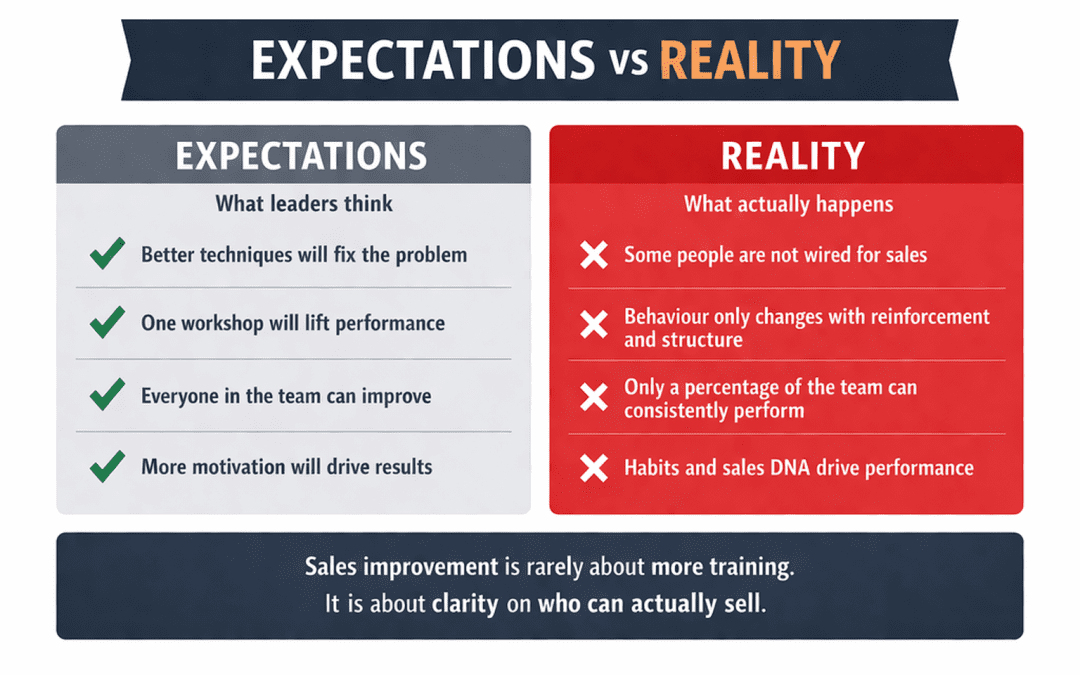
EXPECTATIONS VS REALITY
——————————————————————————————————
Better techniques will fix it / Some people are not wired for sales
One workshop lifts performance / Behaviour only changes with reinforcement
Everyone in the team can improve / Only a percentage consistently perform
Motivation drives results / Habits and sales DNA drive performance
——————————————————————————————————–
The gap between what we expect and what actually happens, that’s what I call the Sales DNA gap.
Most sales trainers operate on the left side of this slide.
The problem is… the business is usually living on the right side.”
Each month, I work with 5 clients to help them operate on the right side. If you are interested, just hit the reply button with “I’m in, and I will send you the details.
Have a great week selling your stuff.
Kind regards
Mike
P.S. If now is not the right time to explore this further, I would still be happy to send you a free copy of my book Selling is Not Optional.
It explains why selling is a conversation rather than a confrontation and outlines the habits that help salespeople prospect, open conversations and close with confidence.
There is no cost and no obligation.
Just reply BOOK, and I will send you a copy.
by Mike Brunel | Mar 18, 2026 | Uncategorized
The Puppy Dog Close (And Why It Still Works)
I grew up on a farm.
We always had dogs. Proper farm dogs. Sheep dogs, cattle dogs. They lived outside, slept in kennels, and had names that only made sense to my father.
They weren’t pets. They were workers.
Fast forward a few years, and I’ve got two young daughters.
One day, they decide they want a puppy.
Now, every parent knows… that’s not really a discussion. That’s a decision that’s already been made.
So off we go to see a breeder with a litter of poodles.
And here’s where it gets interesting.
The breeder says,
“Why don’t you take one home for a couple of nights and see how you get on?”
Now, as the so-called sales guy in the family, I knew exactly what was happening. I am onto you, mate!
This was the classic puppy dog close.
No pressure.
No obligation.
Just take it home… and see what happens.
Of course, what happens is predictable.
You fall in love.
You name the dog Bruno.
And there’s absolutely no chance it’s going back.
So what’s that got to do with sales?
Everything.
If you truly believe in what you sell, you should be willing to let people experience it.
Not hear about it.
Not sit through a pitch.
Actually experience it.
Because when people feel the value, selling becomes unnecessary.
That’s why this works so well:
- Car dealerships offer extended test drives
- Software companies offer free trials
- Some businesses call it a guarantee
- Others call it an irresistible offer
Call it what you like.
It’s simply removing risk and letting the product do the work.
Here’s the real question
Would you be confident enough to let your customer “take the puppy home”?
If not, that’s worth thinking about.
Because the strongest offers in the market all share one thing in common:
They’re easy to say yes to.
What I’m doing right now
I’ve been using this exact principle with my Sales DNA assessment.
So here’s the deal.
I’m giving away a small number of assessments for you or your team to try.
No pressure.
No obligation.
Just experience it and see what it tells you.
If it helps, great.
If not, no problem.
I’ve got three complimentary assessments available this week.
If you’d like one, just reply to this email with “PUPPY”, and I’ll send you the link.
Have a great week selling your stuff.
Mike

by Mike Brunel | Mar 11, 2026 | Leadership, Sales
A simple insight about “priority clients” that turned presentations into almost-guaranteed sales.
Sales Leaders and Sales Managers, a question?
Do you actually know your clients?
One of NRS Media’s great successes was our ability to truly understand our client base.
Knowing who actually bought advertising, and why, was a key factor in the company’s success.
We achieved that by studying the categories of businesses that consistently bought media.
Our business operated globally out of Wellington, New Zealand, Sydney, Australia, then in the USA, UK, Europe, and South Africa, and even Bogota…
We travelled from city to city, working with media companies, presenting advertising opportunities ranging from $5,000 to $20,000 per client per year.
We listed it to only 100 clients. It sold out on those markets year after year.
Over time, we began to notice something interesting.
For certain clients who attended the presentation, almost always bought.
So we decided to analyse the data more carefully.
We didn’t have any sophisticated AI or CRM to manage that data; we just really worked hard with our clients to ask them why they bought.
When we isolated what we called “priority clients,” we discovered something remarkable.
If those clients attended the presentation, close to 100 per cent of them purchased the programme.
But there was another pattern.
These were also the clients who received a personal invitation to attend.
Once we understood that, we became very deliberate about how we treated those prospects.
If someone fitted the priority profile, we did everything possible to get them into the room.
We dressed up invitations in branded-style envelopes.
We delivered invitations in presentation boxes with ribbons.
We hand-delivered them whenever possible. ( Our most successful strategy.)
Sometimes we even picked people up and chauffeured them to the event.
In other words, we treated them like the near-certain sales we knew they were.
As a result, our acquisition costs dropped significantly while our conversion rates remained incredibly high.
The famous copywriter Dan Kennedy calls these people “hidden buyers properly exploited.”
The first key was profile.
We worked out exactly who these buyers were.
We studied their demographics, their behaviours, and the types of businesses most likely to purchase media advertising.
Once we understood that profile, we could predict a sale with high confidence.
The second factor was timing.
Many of our ideal buyers were older, established businesses that wanted to keep their name consistently in front of their customers.
Advertising wasn’t a gamble for them. It was a long-term brand strategy.
There’s a powerful lesson in this for any business.
Once you truly understand who buys your product or service, everything becomes easier.
Your marketing becomes clearer, your sales process becomes more focused, and your conversion rates improve dramatically.
The key is simple.
Find your hidden buyers.
Understand their profile.
And make sure they show up.
Have a great week selling your stuff.
Mike.
P.S. I am looking for 5 Sales Leaders who want to work with me to identify who on your team can sell, who can prospect, and who are trainable.
